IVF & Fertility Treatment in India — Hope, Science and a Fresh Start

For many couples, the journey to parenthood is not straightforward. Years of trying, countless appointments, and the emotional weight of uncertainty — it is one of the most personal and difficult experiences a family can go through. If you have been told that IVF is your next step, or if you have already tried IVF at home without success, India may offer something your own country cannot — world-class fertility care at a fraction of the cost, delivered with compassion and cultural sensitivity.

At SafarTibbi, we have helped couples from the UAE, Saudi Arabia, Kuwait and across Africa access India’s finest fertility clinics. This guide covers everything you need to know — success rates, costs, clinic options, and what the experience is actually like for Arab families.

IVF Treatment in India: Cost, Success Rates & Clinics for Gulf Patients

Why India for IVF?

India is one of the world’s most advanced countries for assisted reproductive technology. It has been performing IVF since 1986 — just eight years after the world’s first IVF baby was born in the UK. Decades of experience, a highly trained pool of reproductive endocrinologists, and state-of-the-art embryology laboratories have made India a global destination for fertility treatment.

But what truly sets India apart for Gulf patients is not just the science — it is the combination of clinical excellence, genuine affordability, and the warmth of care that Arabic-speaking families consistently describe when they return home.

IVF Success Rates in India

Success rates are the most important number in fertility treatment — and India’s leading clinics perform at the highest international levels.

Patient AgeIVF Success Rate in India (per cycle)
Under 3555% – 65%
35 to 3745% – 55%
38 to 4035% – 42%
Over 4020% – 30%
Donor egg IVF (any age)65% – 75%

These figures are from India’s top-tier fertility clinics and are comparable to success rates at leading centres in the US and Europe — at a fraction of the cost.

It is important to understand that no clinic in the world can guarantee a successful pregnancy. Success depends on multiple factors including your age, diagnosis, embryo quality and medical history. What India’s best clinics offer is the highest probability of success, supported by advanced technology and experienced specialists.

Cost of IVF in India vs the Gulf

CountryIVF Cost Per Cycle (USD)Donor Egg IVF
🇮🇳 India$3,000 – $3,500$3,500 – $5,500
🇦🇪 UAE$5,000 – $8,000$8,000 – $14,000
🇸🇦 Saudi Arabia$4,500 – $7,500$9,000 – $15,000
🇬🇧 United Kingdom$6,000 – $10,000$10,000 – $18,000
🇺🇸 United States$12,000 – $20,000$25,000 – $40,000

A couple who has already spent $15,000 on two failed IVF cycles in Dubai can often afford three to four additional attempts in India for the same total budget — significantly improving their overall chances of success.

What Is Included in the IVF Package in India

A standard IVF package at India’s leading fertility clinics typically includes:

Included:

  • Initial consultation and fertility workup
  • Ovarian stimulation monitoring (ultrasounds and blood tests)
  • Egg retrieval procedure
  • Sperm preparation and fertilisation
  • Embryo culture in the laboratory
  • Embryo transfer
  • Luteal phase support medications
  • Pregnancy blood test (beta HCG)

Available as add-ons:

  • Preimplantation Genetic Testing (PGT) — screens embryos for chromosomal abnormalities before transfer
  • Frozen Embryo Transfer (FET) — for couples who wish to freeze and transfer embryos later
  • Donor egg or donor sperm programmes
  • Surrogacy coordination (subject to Indian legal guidelines)
  • ICSI — Intracytoplasmic Sperm Injection for male factor infertility

Fertility Treatments Available in India

India’s top clinics offer the full spectrum of assisted reproductive technology under one roof.

IVF — In Vitro Fertilisation

The most widely known fertility treatment. Eggs are retrieved, fertilised in the laboratory, and the resulting embryo is transferred to the uterus. Suitable for most fertility diagnoses including blocked tubes, unexplained infertility, and ovulation disorders.

ICSI — Intracytoplasmic Sperm Injection

A single healthy sperm is injected directly into each egg. Recommended when male factor infertility is present — low sperm count, poor motility, or abnormal morphology. ICSI is now used in the majority of IVF cycles at India’s leading centres.

IUI — Intrauterine Insemination

A simpler, less invasive procedure where prepared sperm is placed directly into the uterus during ovulation. Recommended as a first-line treatment for mild infertility before moving to IVF.

Donor Egg IVF

For women with diminished ovarian reserve, premature ovarian failure, or repeated IVF failures, donor egg IVF offers significantly higher success rates — typically 65 to 75 percent per cycle. India has regulated donor programmes with thorough medical and genetic screening of donors.

Frozen Embryo Transfer (FET)

Surplus embryos from a fresh IVF cycle are frozen and transferred in a subsequent cycle. FET is increasingly preferred as it allows the uterus to recover naturally and is associated with better outcomes in many cases.

Fertility Preservation

For women facing cancer treatment or those who wish to delay pregnancy, egg freezing is available at India’s top centres using the latest vitrification technology.

Top Fertility Clinics in India for Gulf Patients

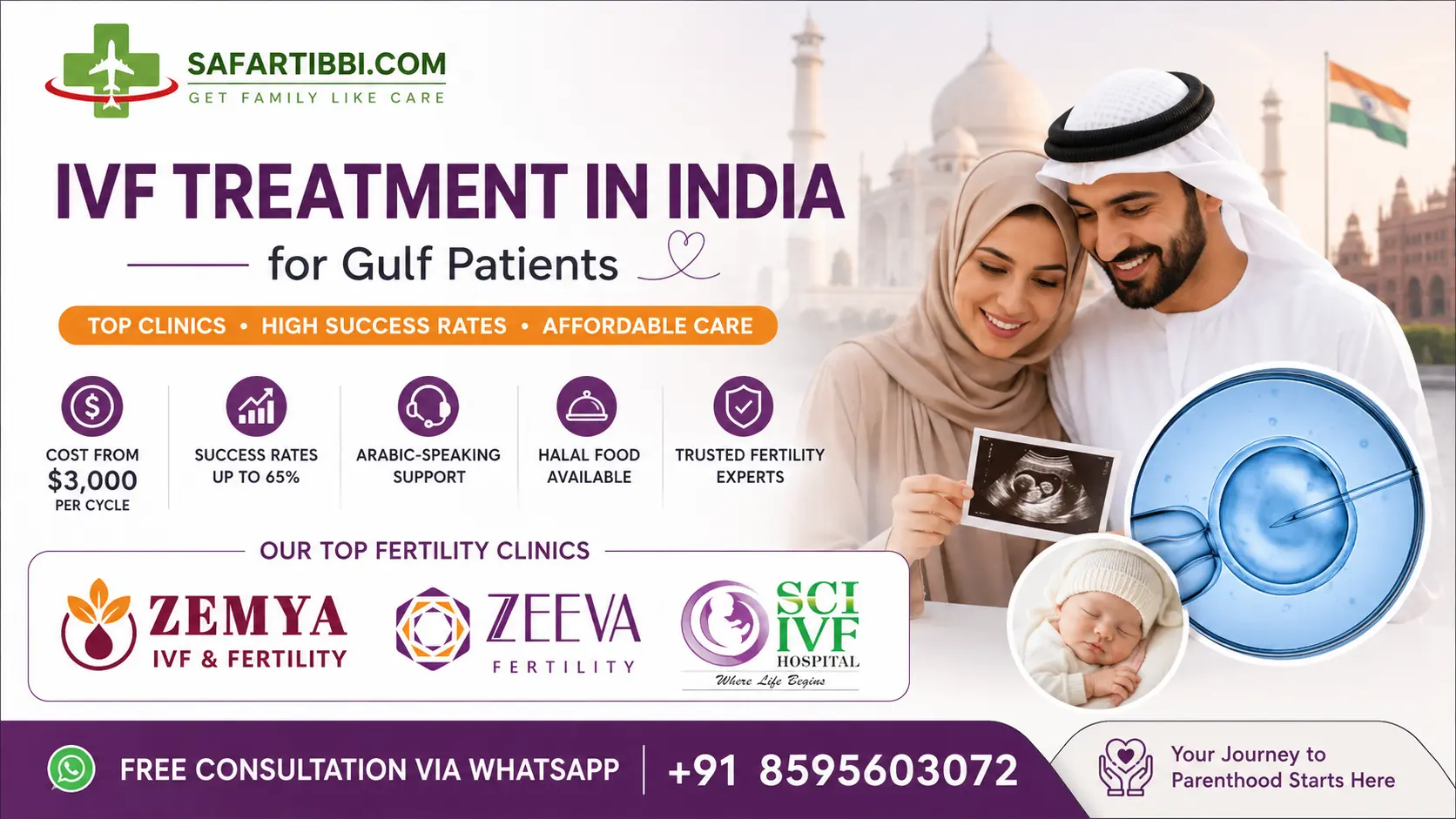
Zemya IVF & Fertility Clinics — Green Park, South Delhi

A specialist fertility centre in South Delhi offering IVF, ICSI, IUI, egg freezing and laser-assisted hatching. Zemya uses RI Witness RFID technology to ensure complete traceability of eggs, sperm and embryos — one of very few clinics in India to do so. Led by Dr. Deeksha Tyagi with 30+ years of experience, the clinic is known for personalised, science-backed care at every step.

Zeeva Fertility — Noida & Delhi NCR

Led by Dr. Shweta Goswami with 20+ years of experience, Zeeva has delivered parenthood to over 5,000 families with a reported IVF success rate of 78%. The clinic has multiple centres across Delhi NCR and a dedicated international patient programme including airport transfers, accommodation and post-treatment access to specialists. Zeeva is known for recommending the most natural path to conception first — never pushing IVF when simpler options exist.

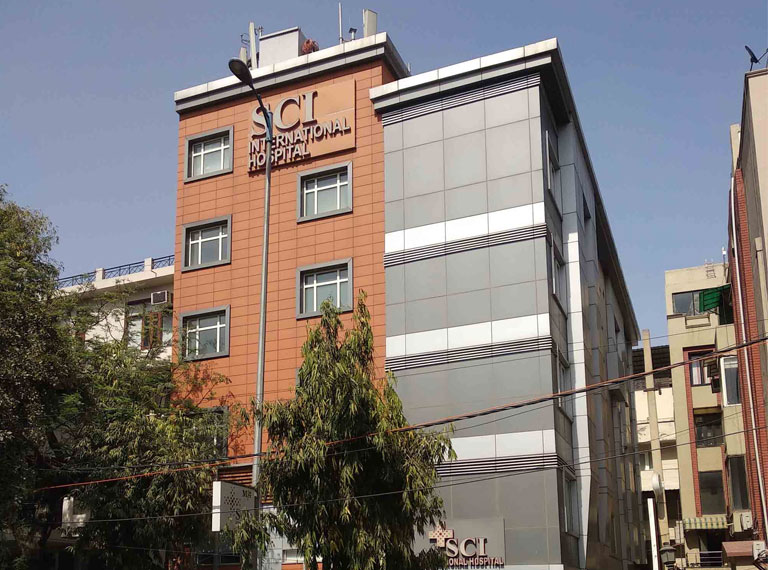
SCI IVF Hospital — South Delhi & Delhi NCR

Established in 2009, SCI IVF has helped families from over 55 countries achieve parenthood under the leadership of Dr. Shivani Sachdev Gour, who trained at Hammersmith Hospital London and the Royal Infirmary of Edinburgh. The clinic offers IVF, ICSI, donor programmes and genetic testing under one roof with full international patient support including online pre-travel consultations. Gulf and African patients are among SCI’s most frequent international visitors.

Arabic-Friendly Care — What to Expect

This is something our patients ask about most. Here is what Gulf families consistently experience when they come to India for IVF through SafarTibbi:

Halal food is available at and around all major fertility clinic locations in Delhi and other hospital cities. Our team arranges meals that meet your dietary requirements throughout your stay.

Prayer facilities are available at all major hospitals and in the accommodations we arrange for our patients.

Arabic-speaking coordination is provided by SafarTibbi throughout your entire stay. Your coordinator attends all consultations with you, translates medical discussions, and is available by phone at any time.

Privacy and dignity are treated with the utmost respect. India’s leading fertility clinics are accustomed to treating patients from conservative cultures and handle all aspects of the process with discretion.

Mahram-friendly environment — male partners are involved and welcomed throughout the process. Clinics are experienced in treating couples together and understand the cultural expectations of Gulf families.

How Long Do You Need to Stay in India for IVF?

A standard fresh IVF cycle requires approximately 14 to 18 days in India from the start of stimulation to embryo transfer.

Typical timeline:

  • Days 1–10: Ovarian stimulation with daily injections — monitored with ultrasound every 2–3 days
  • Day 11–13: Trigger injection to finalise egg maturation
  • Day 12–14: Egg retrieval procedure (under sedation, 20–30 minutes)
  • Day 14–16: Fertilisation and embryo culture in the laboratory
  • Day 17–19: Embryo transfer (a simple, painless procedure)
  • Day 28–30: Pregnancy blood test (can be done back home)

Many couples choose to return home after embryo transfer and take the pregnancy test in their own country — our clinic partners provide full documentation and instructions for follow-up care.


How SafarTibbi Helps Fertility Patients

We understand that fertility treatment is deeply personal. Our approach is different from a standard medical tourism agency.

Step 1 — Private consultation
Contact us on WhatsApp. Share your medical history, previous fertility treatments and test results in complete confidence. Our team reviews your case privately.

Step 2 — Clinic matching
Based on your diagnosis, age, budget and preferences, we recommend the most suitable fertility clinic and specialist for your specific situation.

Step 3 — Treatment planning
We coordinate your consultation, arrange your medical visa invitation letter, and plan your travel dates around your menstrual cycle to ensure you arrive at the right time.

Step 4 — Full support in India
Your Arabic-speaking SafarTibbi coordinator is with you throughout — from the airport to every clinic appointment. We arrange accommodation close to the clinic, halal meals, and transport.

Step 5 — Follow-up care
After you return home, your clinic provides a detailed protocol for the two-week wait and pregnancy test. Our team stays in touch and supports you through the next steps whatever the outcome.

FAQs

Yes. IVF for married heterosexual couples is fully legal in India and widely practised. India's Assisted Reproductive Technology (Regulation) Act 2021 provides a clear legal framework. Donor programmes, surrogacy and other services are subject to specific legal conditions which our team will explain clearly for your situation.
Yes. Your husband will need to provide a sperm sample during the egg retrieval phase. For couples using frozen sperm or donor sperm, this can be arranged differently. Most couples travel together and we recommend this both clinically and emotionally.
For the woman — AMH (ovarian reserve test), Day 2 FSH and estradiol, antral follicle count ultrasound, uterine cavity assessment (hysteroscopy or saline sonogram), and general blood tests. For the man — semen analysis. Share any recent test results with us on WhatsApp and our clinic partner will advise which tests need to be repeated.
A failed cycle is heartbreaking, and we take it seriously. Your doctor will review what happened — fertilisation rates, embryo quality, and uterine receptivity — and adjust the protocol for the next attempt. Many couples succeed on their second or third cycle. The significantly lower cost in India means that multiple attempts are financially possible for most families.
Yes. Frozen embryo transfer is a well-established option. Your embryos are frozen after the fresh cycle and can be transferred in a future visit. Many couples freeze surplus embryos after a successful pregnancy for future family planning. Embryo storage is available at all our partner clinics.

Top Doctors for this Procedure

Doctors and Surgeons on our panel are renowned and highly experienced.

Need assistance for choosing the best doctor for your medical problem?

    Top Hospitals