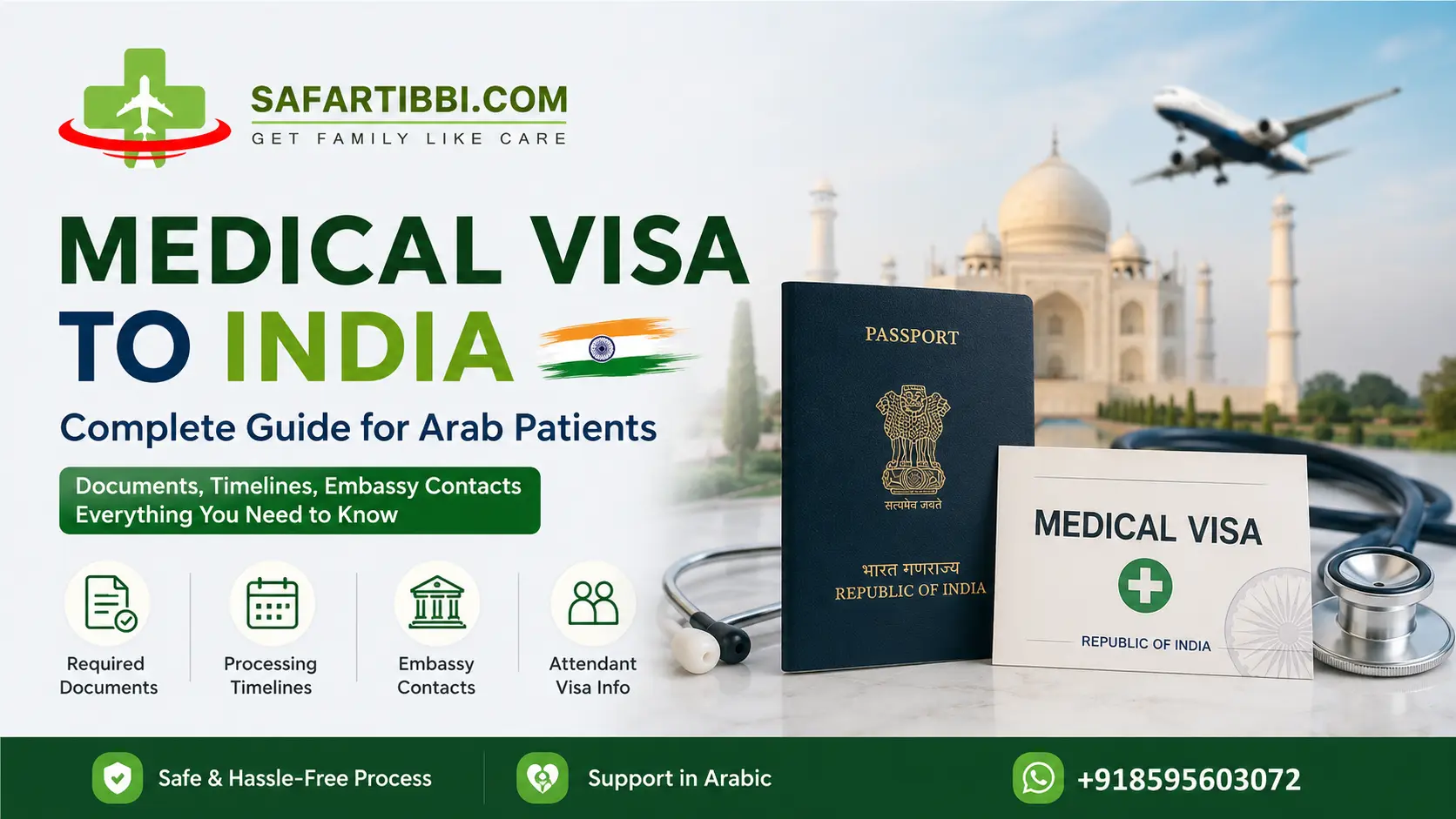
Medical Visa to India: The Complete Guide for Arab Patients (2026)
India has become one of the world’s leading destinations for medical tourism, welcoming hundreds of thousands of international patients every year. Patients from Saudi Arabia, Oman, Iraq, Kuwait, the UAE, Yemen, Sudan, Egypt, Libya, Jordan, and other Arab countries choose India because of its internationally accredited hospitals, highly experienced specialists, advanced medical technology, and affordable treatment costs.
However, before receiving treatment, every international patient must obtain the correct medical visa. Understanding the visa process can save valuable time and prevent unnecessary delays.
This comprehensive guide explains everything Arab patients need to know about obtaining an Indian Medical Visa.
What Is an Indian Medical Visa?
An Indian Medical Visa is a special visa issued to foreign nationals traveling to India exclusively for medical treatment.
Unlike a tourist visa, a medical visa allows patients to legally enter India for consultations, surgery, hospitalization, follow-up treatment, and recovery.
Patients traveling for procedures such as:
- Cardiac Surgery
- Cancer Treatment
- Organ Transplant Evaluation
- Kidney Treatment
- IVF & Fertility Treatment
- Neurosurgery
- Orthopedic Surgery
- Spine Surgery
- Cosmetic Surgery
- Eye Surgery
- Liver Treatment
should always apply under the Medical Visa category whenever applicable.
Types of Medical Visas Available
1. e-Medical Visa
The e-Medical Visa is available for eligible nationalities and is applied for online before travel.
It is suitable for most planned treatments and allows patients to travel without visiting an embassy in many cases.
Key features include:
- Online application
- Electronic approval
- Triple entry
- Intended for medical treatment in recognized hospitals
- Up to two accompanying attendants may apply for e-Medical Attendant visas.
2. Regular Medical Visa
Some nationalities or specific medical situations require applying through the Indian Embassy or Consulate.
This may be necessary when:
- e-Visa is unavailable
- Long-term treatment is planned
- Additional documentation is required
- Embassy verification is necessary
Who Can Apply?
Most international patients seeking genuine medical treatment in India can apply.
Patients should have:
- A valid passport
- A confirmed treatment plan
- An invitation letter from an Indian hospital
- Sufficient financial resources for treatment and stay
Documents Required for an Indian Medical Visa
Although requirements vary slightly by country, the following documents are commonly requested.
Essential Documents
Valid Passport
Your passport should:
- Be valid for at least six months from the date of arrival
- Have at least two blank pages
Passport Photograph
Recent color photograph with:
- White background
- Clear face
- No shadows
Hospital Invitation Letter
One of the most important documents.
The invitation should include:
- Patient’s full name
- Passport number
- Diagnosis
- Recommended treatment
- Expected admission date
- Hospital letterhead
- Authorized hospital signature
Medical Reports
Prepare copies of:
- Doctor consultation notes
- MRI or CT scans
- Blood investigations
- Pathology reports
- Biopsy reports
- Previous surgery records
- Discharge summaries
English reports are preferred. If your reports are in Arabic, certified translations may help speed up the review.
Financial Documents
Some embassies may request proof that treatment expenses can be covered.
Examples include:
- Bank statement
- Sponsor letter
- Insurance approval (if applicable)
Requirements vary depending on the embassy and case.
Medical Attendant Visa
Patients often travel with family members.
India allows accompanying relatives to apply for a Medical Attendant Visa.
Usually:
- Up to two attendants are permitted
- The attendant’s visa is linked to the patient’s medical visa
- Immediate family members are generally preferred.
Medical Visa Processing Timeline
Although timelines vary by nationality and embassy workload, a typical process is:
| Step | Estimated Time |
|---|---|
| Medical report review by hospital | 24–48 hours |
| Hospital invitation letter | 1–3 working days |
| Online visa application | 20–30 minutes |
| Visa processing | 2–7 working days (varies by country) |
| Travel preparation | 2–5 days |
Patients requiring urgent surgery should begin the process as early as possible.
Step-by-Step Medical Visa Process
Step 1
Contact an Indian hospital or an authorized medical facilitator.
Step 2
Share medical reports for specialist evaluation.
Step 3
Receive:
Treatment recommendation
Cost estimate
Medical invitation letter
Step 4
Complete the visa application through the official Government of India portal or, if required, submit a regular visa application through the Indian Embassy or Consulate.
Step 5
Upload required documents and pay the applicable visa fee.
Step 6
Wait for visa approval.
Step 7
Book flights after receiving confirmation.
Step 8
Travel to India and begin treatment.
Indian Embassy & Consulate Support
Every Arab country has an Indian Embassy or Consulate that handles visa-related matters.
Examples include:
- Embassy of India – Riyadh
- Embassy of India – Abu Dhabi
- Embassy of India – Muscat
- Embassy of India – Kuwait City
- Embassy of India – Baghdad
- Embassy of India – Doha
- Embassy of India – Cairo
- Embassy of India – Amman
Patients should always refer to the official Indian mission serving their country for country-specific document requirements.
Common Reasons for Visa Delays
Visa processing may be delayed because of:
- Passport nearing expiry
- Missing hospital invitation letter
- Incomplete medical reports
- Mismatched passport information
- Poor-quality scanned documents
- Incorrect visa category
- Errors in the online application
Double-check all documents before submission to avoid unnecessary delays.
Tips for Arab Patients Traveling to India
Before departure:
✓ Carry printed copies of all medical records.
✓ Bring all current medications.
✓ Keep your passport and visa approval easily accessible.
✓ Share your travel itinerary with the hospital.
✓ Confirm airport pickup arrangements.
✓ Save emergency contact numbers.
✓ Carry some local currency or an international payment card.
How SafarTibbi Can Help
Applying for a medical visa can seem complicated, especially when you’re focused on your health. SafarTibbi assists Arab patients throughout the entire journey by coordinating with leading Indian hospitals and helping prepare the required documentation.
Our services include:
- Free medical opinion from top specialists
- Hospital appointment booking
- Medical invitation letter
- Cost estimation
- Medical visa guidance
- Airport pickup
- Arabic interpreter support
- Hotel and accommodation assistance
- Treatment coordination
- Post-treatment follow-up
Our goal is to make your medical journey to India safe, smooth, and stress-free.
Final Thoughts
A well-prepared medical visa application is the first step toward successful treatment in India. By gathering the correct documents, choosing the right visa category, and working with an experienced medical travel facilitator, Arab patients can avoid delays and focus on what truly matters—receiving world-class healthcare.
Whether you are planning heart surgery, cancer treatment, IVF, orthopedic surgery, neurosurgery, or any specialized medical care, preparing your visa early will help ensure a smooth and successful medical journey.
FAQs
Top Doctors for this Procedure
Doctors and Surgeons on our panel are renowned and highly experienced.
Our Procedures
- Ankle Replacement Surgery
- Arterial Switch Procedure
- Breast Cancer Treatment in India
- Cornea Transplant in India
- Elbow Replacement Surgery
- Eye Treatment in India
- Glaucoma Surgery in India
- Fontan Procedure in India
- Heart Valve Surgery
- Hip Replacement Surgery
- Hysteroscopy Procedure in India
- ICL Procedure
- ICSI Procedure in India
- IUI Procedure in India
- IVF Procedure in India
- Kidney Transplant
- Knee Arthroscopy in India
- Knee Replacement Surgery
- Laminectomy Surgery in India
- View All